















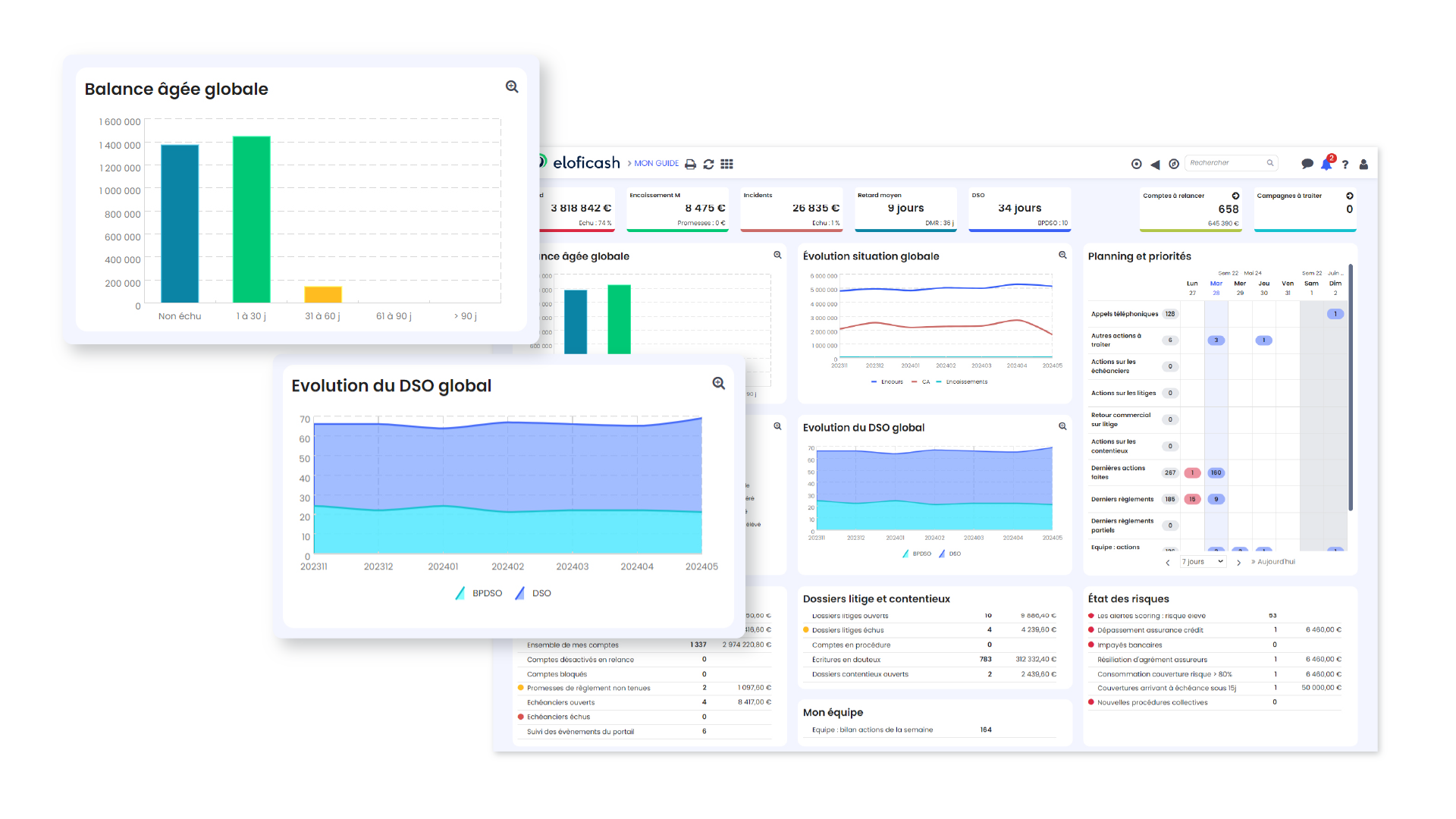
Measure your DSO and track its evolution over time
Identify the causes of your late payments and take action more quickly with Eloficash, a SaaS which allows you to analyse your DSO in real time and understand where to focus your efforts to speed up cash collection.
✔ Real-time DSO tracking
✔ Analysis by customer, segment or entity
✔ Identification of factors contributing to an increase in DSO
✔ Dedicated dashboards for managing accounts receivable
Thanks to these analyses, your teams will have a clear picture of the much needed actions in order to reduce your DSO in the long term.
Prioritise your collection activities to reduce DSO
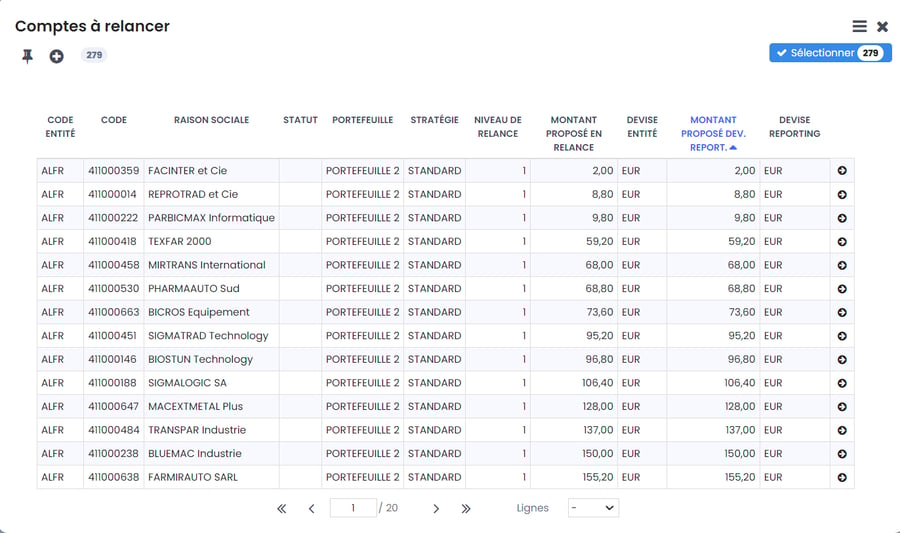
Focus your teams on high-value customers and maximise the impact of each reminder to effectively reduce DSO, whilst prioritising the right actions at the right time.
With Eloficash, your teams have access to smart worklists that automatically identify which accounts to prioritise based on payment delays, outstanding balances and payment behaviour.
✔ Automatically generated worklists
✔ Prioritisation of accounts with a high impact on cash flow
✔ Clear overview of outstanding invoices to be followed up
As soon as they log in each morning, every account manager knows which accounts to prioritise in order to maximise the impact of their actions and speed up collections.
Centralise, track and resolve customer disputes faster
Disputes are one of the main causes of longer DSO. A disputed invoice can remain on hold for several weeks if the process isn’t properly organised.
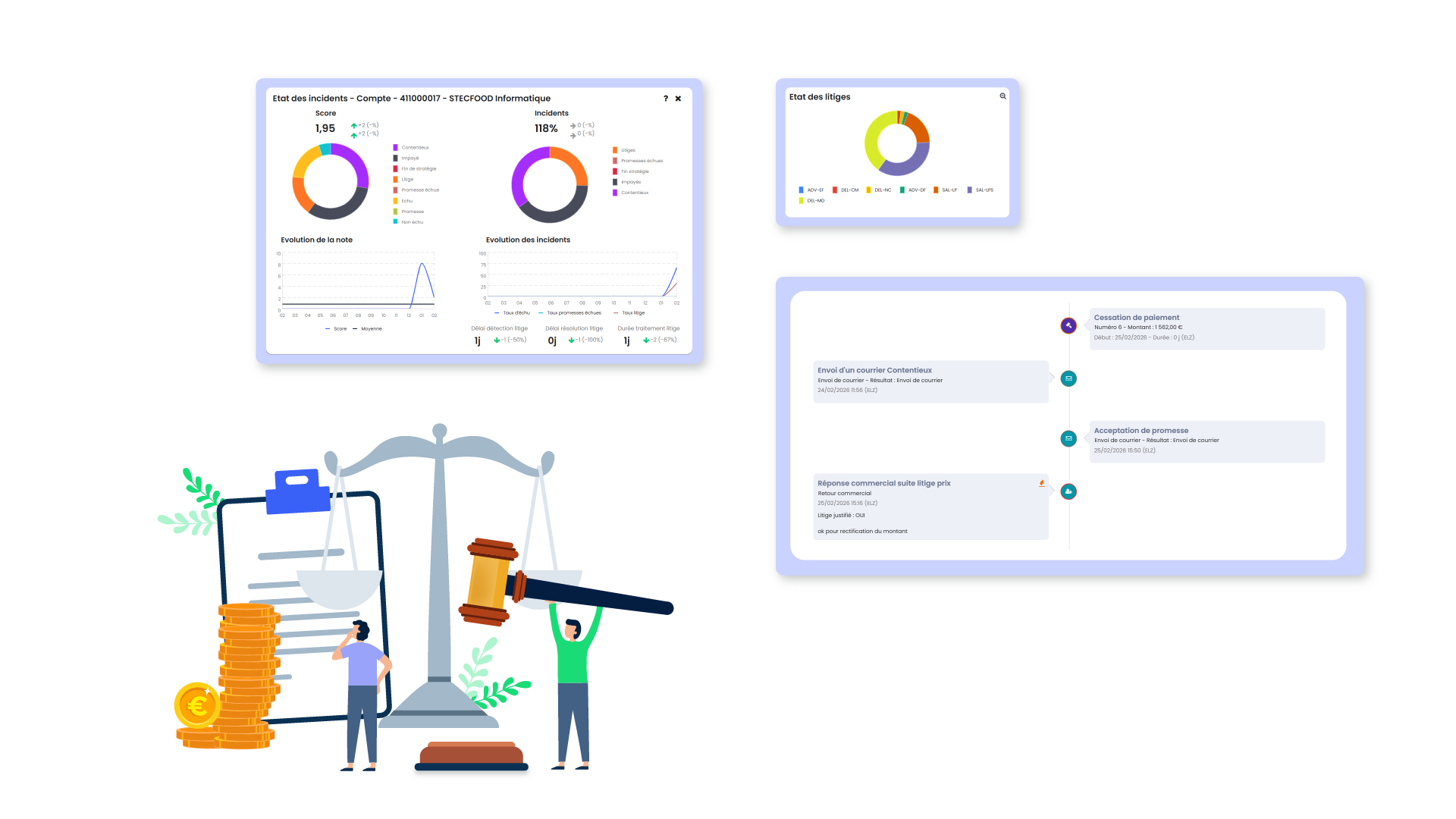
With Eloficash, disputes are centralised, tracked and resolved more quickly to unblock payments.
✔ Reporting and tracking of disputes in a dedicated tool
✔ Complete history of communications with the customer
✔ Assignment of tasks to the relevant teams
✔ Tracking of the resolution process through to payment
By resolving disputes more quickly, you can release outstanding invoices and accelerate the reduction in DSO.
Do you have any questions about reducing your DSO using software?
What is DSO and how is it calculated?
DSO is an English acronym used in the field of financial management and debt collection. It is a performance indicator for a company and its credit function. It measures the time between the issuing of an invoice and its collection. It is expressed in days of turnover.
The term stands for ‘Days Sales Outstanding’ (D for Daily, O for Outstanding and S for Sales). It therefore corresponds to the average payment period for invoices issued. In French, the acronym DSO is translated as DMP, standing for ‘Délai moyen de Paiement client’ (average customer payment period), or NJC, standing for ‘Nombre de jours de Crédit client’ (number of days’ customer credit).

Calculating DSO using the accounting method
Consequently, the lower the DSO, the faster customers pay. Conversely, the higher the customer DSO, the longer the payment period. Your finance director or credit management team must therefore find ways to reduce these customer payment periods. In this way, they will ensure the financial health of your business.
How do you measure your DSO? An essential for an effective cash flow management
This calculation is, of course, not the only indicator that the company’s credit manager needs to take into account. It remains, however, essential for optimising receivables management and improving the company’s cash flow. Measuring the average payment term does, in fact, enable the establishment of a monitoring and performance indicator. The aim is to speed up cash inflows in order to reduce this period and thereby improve working capital requirements (WCR).
Working capital requirements, expressed in number of days, are broken down into three ratios:
- DIO (Days Inventories Outstanding) – inventory turnover ratio: this calculation of the inventory turnover period assesses the average stock of an item in terms of the number of days.
- The DPO ratio – supplier credit turnover ratio: the DPO calculation gives the average time taken to settle trade payables.
- DSO – accounts receivable turnover ratio: the average time taken for customers to settle their accounts.
Good to know: theCash Conversion Cycle (CCC) combines these three ratios. The time required, in days, to convert stock into cash is calculated as follows: DIO + DSO – DPO. It should be as low as possible.
Calculating the DSO provides an indication of your company’s financial situation. It should therefore encourage your debt collection manager to implement customer risk management strategies. These will help to minimise the risk of unpaid debts and safeguard cash flow. Be careful, however! If you wish to improve your company’s working capital, this is not the only lever to pull…
How do you calculate your Days Sales Outstanding?
There are several possible methods of calculation:
The accounting method for calculating DSO
The basic formula is as follows:
(Receivables incl. VAT / Turnover incl. VAT) × Number of days
This method has the advantage of being simple. However, it can produce significant variations depending on the period defined (60, 90, 120 days). Furthermore, it does not adequately account for seasonality and sharp fluctuations in turnover.
The‘count-back’ method
The ‘count back’ method, on the other hand, involves deducting each month’s turnover (including VAT) from the outstanding balance until it is fully utilised, and then adding up the number of days in each of the corresponding months.
Its advantage lies in the fact that it takes into account seasonality and significant fluctuations in turnover. However, the ‘count-back’ method combines current receivables with past-due receivables.
Tip: find out how to calculate the bestpossible DSO( , BPDSO). This involves determining the optimal time for collecting receivables using current trade receivables.
How can you improve your average payment period (APP)?
To improve your DSO, you can therefore take action on:
- the time taken for each debtor to settle outstanding amounts
- or the time taken to resolve disputes, litigation and the amicable recovery of outstanding debts (DSO for disputes)
- or the time taken and the automation of the customer debtrecovery process (alerts, customer reminders, etc.)
ELOFICASH solution: our software for reducing DSO and collecting customer receivables helps you to improve your customer collection process. It enables you to optimise your DSO and your cash flow management. Customer invoice reminders, KPIs, task management, payment terms… some customers report an improvement of more than 5 days in their DSO thanks to the tools available in our receivables management software!