










Automate payment reminders and accelerate cash collection with Eloficash.
Send your customer reminders automatically, track your outstanding invoices and reduce your payment terms with customer reminder software!
They trust Eloficash to manage their collections💚
Manage your customer reminders strategically
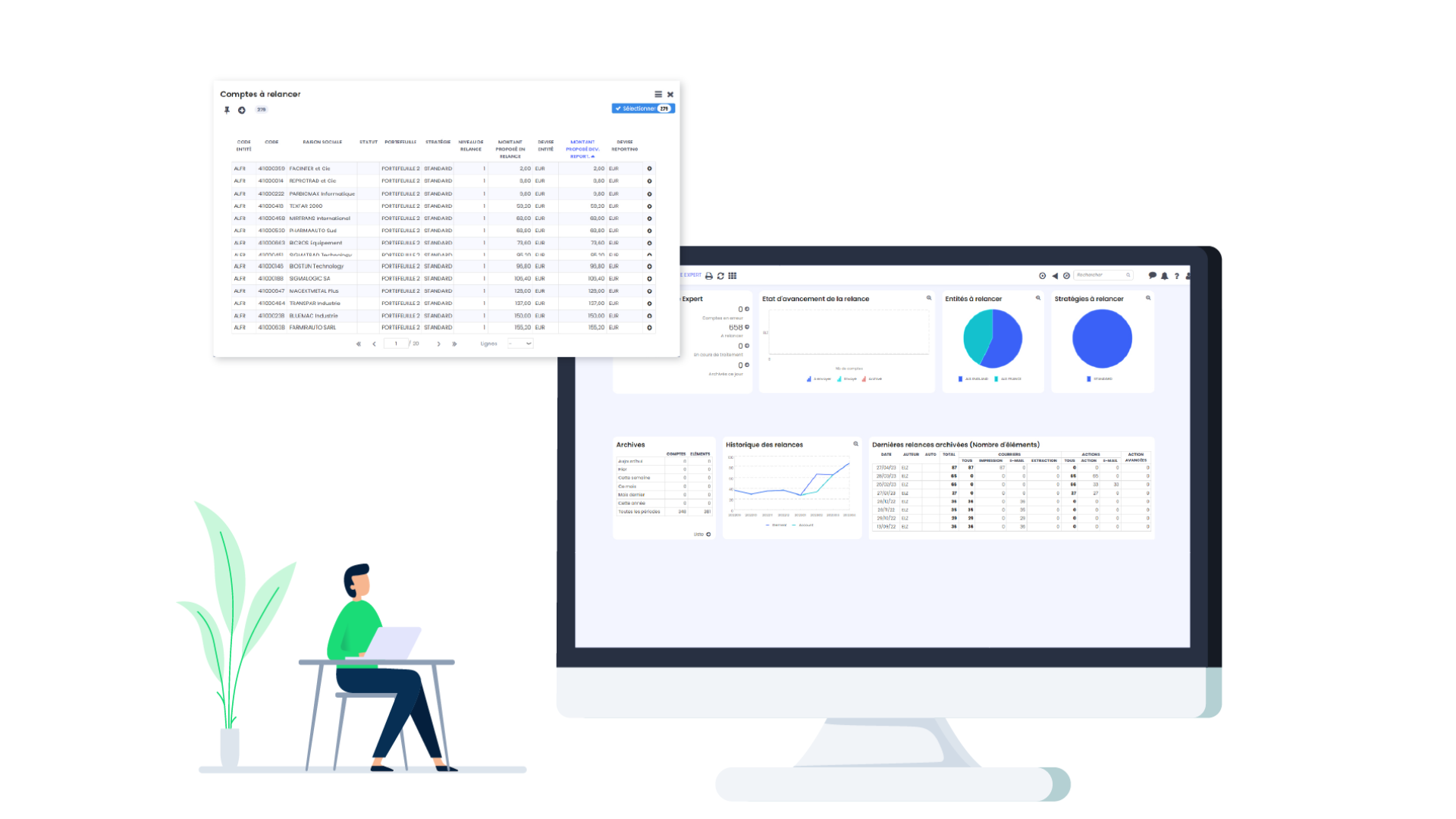
Develop an effective debt recovery strategy with a clear overview of your invoices and their status.
Eloficash allows you to track your outstanding payments in real time and identify priorities so you can take action at the right time - and even automate most of your recurring tasks.
✔ View overdue and upcoming invoices
✔ Identification of late payments and high-risk accounts
✔ Prioritise actions based on amounts and payment deadlines
✔ Track changes in DSO
➡️ You’ll move from reactive debt collection to a proactive recovery strategy.
Automate your payment reminder campaigns
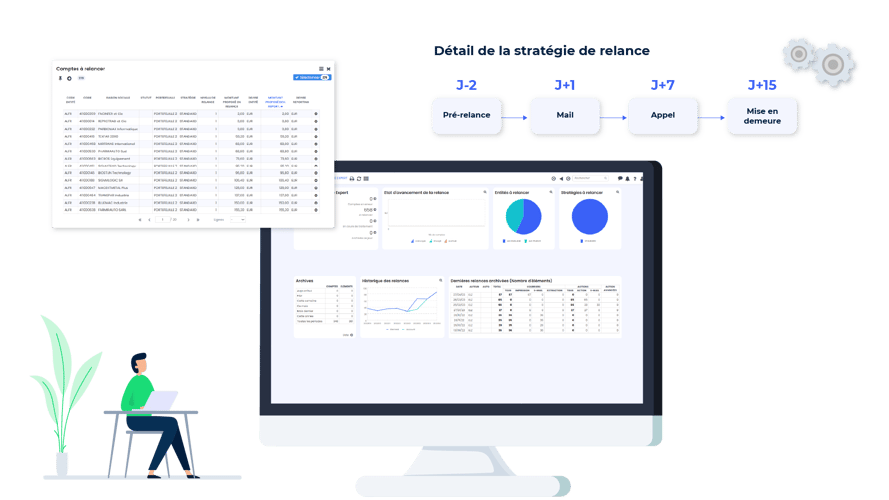
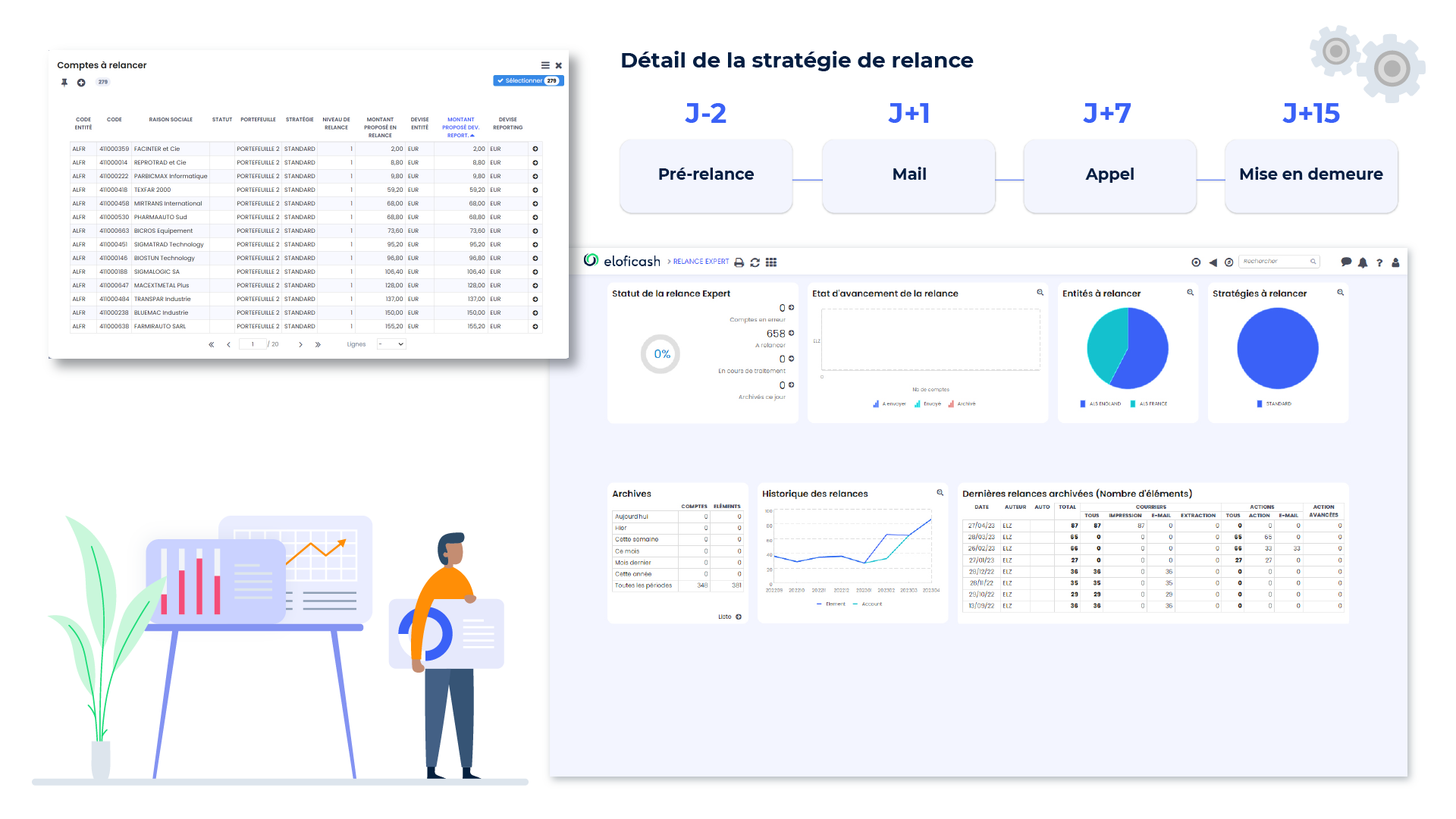
Eliminate manual tasks by setting up automated workflows tailored to each situation: before the due date, after a payment is overdue, or in the event of non-payment. Each action is triggered at the right time, without any intervention from your teams.
✔ Automatic scheduling of payment reminders
✔ Scheduling of campaigns by customer segment
✔ Multi-channel reminders (email, post, etc.)
✔ Automatic triggering based on invoice status
✔ Complete history of interactions
➡️ You can ensure your payments are collected whilst saving valuable time.
Customise your reminder templates
Every customer is different and your reminders should be too.
Eloficash allows you to create tailored scenarios to maximise impact without damaging customer relations.
✔ Personalised scenarios based on customer profile
✔ Tailored tone and content of messages
✔ Management of escalation steps (reminder, formal notice, etc.)
✔ Taking payment behaviour into account
➡️ You improve your collection rate whilst maintaining the business relationship.
Before: Ineffective reminders vs. With: an effective debt recovery process
❌ Cash tied up in trade receivables
❌ Lack of visibility on future cash inflows
❌ Finance teams overburdened with manual tasks
❌ Difficulty in effectively managing accounts receivable
✅ Automated reminders based on customised scenarios
✅ Messages tailored to your customer’s behaviour
✅ Clear tracking of every follow-up action
✅ Easier coordination between teams
Measurable results achieved by our customers within the first few months:
10 days
reduction in average DSO
-30%
reduction in overdue receivables
80%
Up to 80% of repetitive tasks automated
70%
less time spent managing disputes
To find out more...
In just a few pages, discover all the features of your future financial CRM and get ready to reduce your payment times by 20 per cent.
They say it better than we do 💚

“As our group grew, Excel – the credit manager’s best friend – proved insufficient for managing our debt collection processes, freeing us from time-consuming administrative tasks and handling an exponential volume of data. An intuitive and scalable business solution such as Eloficash was essential to address the key challenges of automating tasks, speeding up debt recovery, anticipating risks and developing a cash-focused culture.”
Do you have any questions about Eloficash, your software for chasing unpaid invoices?
What is an unpaid invoice, and why is it important to follow up on it?
Unpaid invoices represent amounts due that have not been settled by the due date. Without an effective debt collection process, these outstanding payments can undermine the company’s financial stability. Here’s why it is essential to put in place a process for collecting unpaid invoices.
Establishing an effective debt recovery process
Planning for the worst-case scenario allows you to reflect, anticipate and, above all, act as effectively as possible. According to a recent study carried out by the Plum Institute, more than 8 per cent of invoices issued by businesses in France are never paid or are paid so late that they are considered ‘written off’. When an invoice is late in being paid, the risk of non-payment increases considerably, reducing the chances of recovery. Indeed, the longer the payment period, the greater the likelihood of non-payment, which impacts cash flow and increases the need for provisions for doubtful debts.
Consequently, the recovery of outstanding debts is an issue that must be integrated into the management of your accounts receivable, with a specific approach, processes and practices for credit management.
Debt recovery: a team effort
The management of unpaid invoices relies on active collaboration between several departments. The sales team, through its close contact with customers, plays a key role in quickly identifying warning signs and maintaining open communication. When reminders from the sales team and attempts at amicable debt recovery negotiations fail, the Credit Manager, the Financial Controller or the Debt Recovery Officer must be able to make the ‘right decisions’ and implement the most efficient litigation-based recovery techniques for managing debts over 90 days past due.
A receivables management software solution such as Eloficash is essential for ensuring an efficient litigation process and recovering sums owed by defaulting customers, thanks to specific commercial intelligence. Eloficash facilitates teamwork by centralising all information relating to debt recovery, enabling everyone involved — from the sales representative to the Credit Manager, including the management accountant and the Debt Collection Officer — to have a comprehensive overview of the status of outstanding debts.
Making the ‘right decisions’ regarding unpaid invoices
How do you get paid? When should you follow up with your customer? How should you follow up with your customer? Here are the right decisions to make regarding your unpaid invoices to ensure you recover your cash quickly.
When should you follow up on an unpaid invoice?
The follow-up of an unpaid invoice must be approached strategically to maximise the chances of recovery whilst maintaining the customer relationship. However, it is essential to act as quickly as possible when faced with a late payment. Indeed, the longer the debt remains outstanding, the lower the success rate of recovering the amount due – falling to 5 per cent after more than 360 days.
A reminder for an invoice must therefore be sent as soon as a delay in payment is noted. This depends on the maximum payment term agreed between the two companies. Usually, this period is set at 30 days (from the date the invoice is sent, the goods are received or the service is provided), but this period may vary and be extended to up to 45 days. It is the contract between the two companies that determines the payment terms and method.
How do you write a reminder letter for an unpaid invoice?
To ensure a reminder letter is effective and legally compliant, certain rules must be followed. Here are a few points to include in your letter:
1. The reference number of the outstanding invoice.
2. The invoice date and the payment due date.
3. The amount due.
4. The contact details of the company and the customer in arrears.
You can also use a reminder letter template, which you can customise yourself.
When drafting your reminder letter, you should be diplomatic whilst making it clear that you intend to be paid. You should also offer your customer or supplier the opportunity to contact you to resolve any misunderstanding. Finally, don’t forget to attach a copy of the outstanding invoice to your letter or email. If you do not receive a reply, you can send a further reminder by registered post.
Using software to automate reminders
A debt collection software solution such as Eloficash helps to optimise the monitoring of your aged receivables, automates reminders, sends alerts via text message or email, and enables the issuance of a formal demand for payment (via registered post) or even a payment order. If reminders go unanswered and/or the reasons for non-payment remain unclear, the Credit Manager, the creditor or the Debt Collection Officer must decide on the course of action to take: write off the debt, refer it to a debt collection specialist, or initiate legal proceedings for debt recovery.
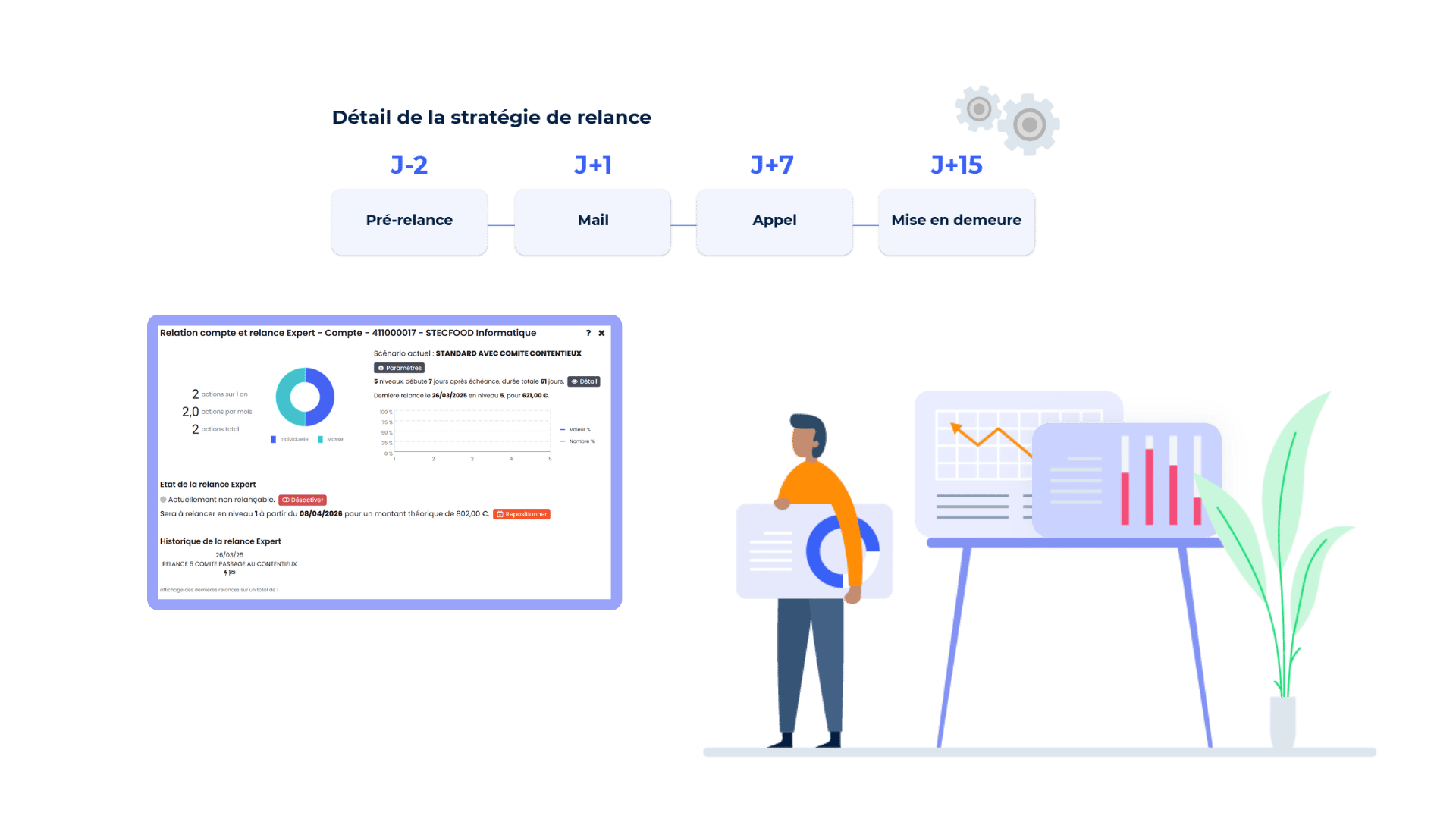
With Eloficash’s Relance Expert, send out mass reminders to your customers using pre-defined, personalised reminder templates! For example, you can choose to create a ‘Standard’ reminder strategy applicable to all your customers. However, if you have key accounts amongst your customers, you will need to adapt your reminder strategy. You can therefore create a ‘key accounts’ reminder template, applicable to the customers of your choice.
With Eloficash, you can automate, adapt and personalise your reminders for unpaid invoices, tailored to your specific clients.
Defining your strategy and reminder stages clearly
Adhering to reminder deadlines is crucial to ensuring effective follow-up and increasing your chances of recovery, here's an example :
1. First reminder: 7 to 10 days after the due date. Reminder by email or telephone.
2. Second reminder (friendly reminder): 15 days after the first reminder.
3. Formal notice letter: sent approximately 30 days after the first reminder.
In the event of a dispute, Eloficash enables you to maintain a record and ensure clear traceability of events.
At the heart of a formalised dispute resolution process initiated by the company, the aim is to assess, depending on the type and the ‘delay’ in payment of the debt owed, the cost and success rate, and even any potential compensation and costs – late payment penalties and damages for late payment – according to various scenarios.
Preparing and managing legal proceedings
If amicable reminders have proved insufficient, you can initiate legal proceedings. Here’s how to prepare and initiate legal action to recover your funds.
How do you prepare for legal proceedings over an unpaid invoice?
As a last resort, when all attempts at an amicable resolution have failed, legal proceedings may be considered.
- Payment order: a swift remedy, either through a bailiff or directly by the company, for a simplified legal procedure. It does not require the parties to be present and can be obtained by providing supporting documents for the debt. The order for payment on the ‘CERFA form’ can be issued directly by the company and acts as a significant psychological lever in debt recovery.
- Summons for payment : in the event of a larger sum or bad faith on the part of the debtor, court proceedings may be considered: a summons for summary proceedings or a summons on the merits. A summonsfor interim relief is a fast-track procedure to obtain a provisional ruling in urgent cases, whilst a summonson the merits serves to resolve a dispute definitively following a detailed examination of the facts and arguments. The former is used for urgent measures, whilst the latter allows the dispute to be settled on its merits.
What should you do after receiving a summons to pay?
Once a payment order has been issued, the final recourse is to initiate legal proceedings. A debt recovery software solution, following a defined workflow, supports you in preparing litigation files and managing legal proceedings, in accordance with the relevant procedures and jurisdictions.
Centralisation of invoices and action planning
As well as centralising the supporting evidence (quotations, purchase orders, invoices) for the service provided, the solution can schedule deadlines for producing and sending highly formalised documents, in accordance with legally binding court procedures.
Point to note: the responsiveness and processes of a court vary depending on your geographical location. Longer processing and hearing times, unfilled vacancies, and backlogs in the courts (usually in the commercial court) or before bailiffs are regularly in the news.
Writing off a debt as a bad debt
If a debt needs to be written off, particularly in the event of compulsory liquidation or insurmountable difficulties faced by the customer(s), the Eloficash debt recovery software solution can assist you. Depending on the type of debt and the customer reminder process in place, Eloficash can prepare provisions for write-offs at regular intervals. In conclusion, receivables written off must not account for more than 3 per cent of your trade receivables; otherwise, corrective measures must be taken promptly!
Another solution: entrust the matter to a debt recovery specialist
Outsourcing to a ‘tailor-made’ specialist or a debt collection agency significantly improves the chances of recovering outstanding debts, whilst preserving the business relationship. Ownership of the debt is transferred to a ‘third party’ for a specified period. This method helps to break a deadlock, facilitate commercial negotiations, or even set up a payment plan – the preferred solution of a debt collection agency. The Eloficash cash flow management software enables you, via computerised exchanges, to monitor the actions of your external service provider, assess the ‘compromise’ andidentify the risks of insolvency in order to ensure sound financial management.
Tip: Outsourcing the debt recovery process is particularly beneficial when dealing with foreign debtors, given the specific local legal and regulatory environments.
Chasing unpaid invoices: an essential step for the health of your business
Chasing unpaid invoices is an essential practice for any business wishing to ensure its long-term financial viability. With structured chasing methods, the use of effective tools and clear procedures, it is possible to significantly improve debt recovery. Remember that consistency and rigour are key to avoiding unpaid invoices. Proactive management of unpaid invoices is crucial for maintaining your business’s financial health. By systematically following up with customers in arrears and implementing appropriate debt recovery measures, you reduce the risk of bad debts and optimise your cash flow. Effective follow-up, combined with good communication with your customers, not only helps to recover amounts owed but also helps to maintain long-term business relationships.